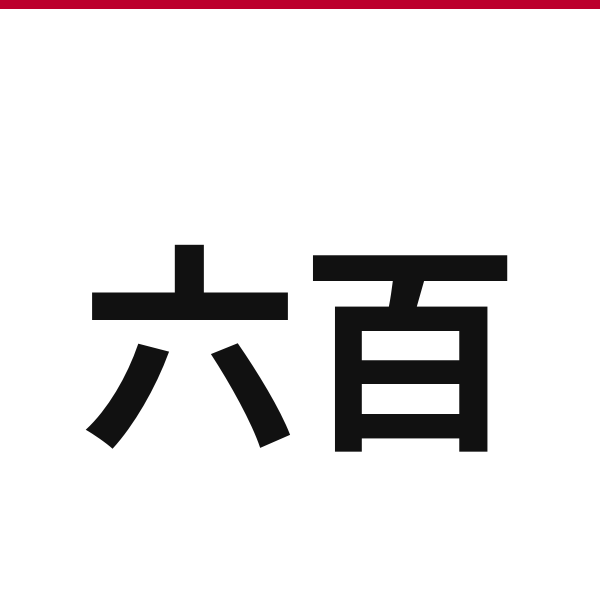
How to use "600" in a sentence
Here are practical examples in polite everyday Japanese:
Other ways of saying "600" in Japanese
Japanese has multiple counting systems, so "600" changes depending on what you are counting:
- roppyaku (六百) — Standard number 600. Note the sound change from roku to rop before hyaku.
- roppyaku-mai (六百枚) — Counter for flat objects — 600 sheets, tickets, or shirts.
- roppyaku-hon (六百本) — Counter for long objects — 600 bottles, pencils, or umbrellas.
- roppyaku-dai (六百台) — Counter for machines and vehicles — 600 cars, computers, or televisions.
- roppyaku-nin (六百人) — Counter for people — 600 people.
- roppyaku-sai (六百歳) — Age — 600 years old. Used for institutions, not people.
Six hundred is a major leap from 50 in Japanese, introducing the hyaku hundred counter with a sound change that trips up many learners. Returning to smaller digits, 3 in Japanese uses the same first character but without the hundred multiplier. For another number with a dramatic sound shift, 19 in Japanese shows how counters can transform unexpectedly in compound readings.
Fun fact about "600" in Japanese culture
Roppyaku en (600 yen) is a psychological price point that appears everywhere in Japanese consumer culture. All-you-can-drink bars, karaoke rooms, and ramen shops frequently charge exactly 600 yen for entry or a set menu because the number feels accessible without seeming cheap. Part-time workers in smaller cities reference 'roppyaku en' as a standard hourly wage, and 600-yen bento boxes dominate convenience store shelves. The number has become so embedded in daily economics that Japanese consumers instinctively evaluate whether a service is fairly priced by comparing it to this 600-yen baseline.
Noh theater, Japan's oldest surviving dramatic form, traces its modern origins to Zeami Motokiyo in the 14th century — roughly 600 years ago. UNESCO recognizes Noh as an Intangible Cultural Heritage, and the tradition continues with five major schools that perform regularly at the National Noh Theatre in Tokyo. The minimalist stage, carved wooden masks, and slow, deliberate movements have influenced Western theater practitioners including Bertolt Brecht and Jerzy Grotowski. Surviving 600 years of civil wars, modernization campaigns, and the rise of pop culture is a testament to Noh's spiritual depth and its role as a meditation medium rather than mere entertainment.
Fushimi Inari Shrine in Kyoto, famous for its tunnel of 10,000 vermillion torii gates, features approximately 600 steps to reach the first major viewpoint on the mountain trail. Hikers count these steps as they climb through the gates, and the 600-step mark serves as a psychological halfway point where casual visitors often turn back while serious pilgrims press on to the summit. Local folklore suggests that walking these 600 steps cleanses half of your accumulated misfortunes, requiring a full summit climb to achieve complete spiritual renewal. The number 600 thus represents a threshold between casual tourism and genuine religious commitment.
Japanese corporations often celebrate their 600th anniversary as a mark of true institutional permanence. While Western companies rarely survive a century, Japanese enterprises like Kongō Gumi (founded in 578 AD) and Nishiyama Onsen Keiunkan (founded in 705 AD) have operated for over 1,300 years. The 600-year milestone is therefore not mythical in Japan — it is a documented reality for several family businesses that have survived wars, earthquakes, and economic collapses. These companies view 600 years as proof that their craft traditions have transcended generations.
The roppyaku reading introduces one of Japanese counting's most important phonetic rules: the sound change (rendaku) that transforms certain numbers when they combine with counters. Roku becomes rop before hyaku, hachi becomes hap, and hyaku becomes byaku after certain digits. This system confuses beginners but follows consistent patterns that native speakers absorb unconsciously. Mastering 600 is therefore a gateway to understanding how Japanese numbers behave in compound forms, making it a crucial milestone for anyone serious about counting naturally.
Japanese railway companies maintain approximately 600 active train stations in the Greater Tokyo Area alone, making the number a daily reality for millions of commuters. The Yamanote Line, which loops central Tokyo, connects 29 stations but operates within a network where 600 stations function as transfer points. Commuters develop intimate knowledge of these stations, referring to them by nicknames and memorizing the exact walking distances between platforms. The 600-station network is so complex that navigation apps dedicate entire algorithms to calculating optimal transfer routes, and missing one connection can cascade into a thirty-minute delay across the entire system.