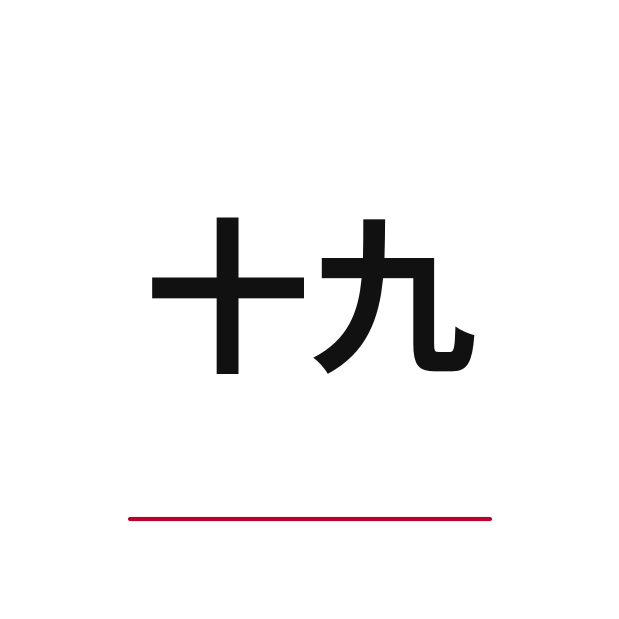
How to use "19" in a sentence
Here are 5 practical examples in polite everyday Japanese:
Other ways of saying "19" in Japanese
Japanese has multiple counting systems, so "19" changes depending on what you're counting:
- juukyuu (十九) — Standard reading — 10 + 9.
- juuku (十九) — Alternative reading, used in some contexts like phone numbers.
- juukyuu-sai (十九歳) — Age 19 — final year of high school, university entrance exam year.
- juukyuu-mai (十九枚) — Counter for flat objects — 19 sheets.
- juukyuu-ban (十九番) — Number 19 in a sequence.
Learn how to say 18 in Japanese. Learn how to say 20 in Japanese. Learn how to say 17 in Japanese.
Fun fact about "19" in Japanese culture
In Japan, 19 is the age of maximum academic pressure. It's the final year of high school, when students take the university entrance exams that determine their entire future. The Japanese call this period juken jigoku (exam hell), and 19-year-olds are at the epicenter. Many students study 12+ hours daily, attend cram schools until midnight, and experience severe stress. The number 19 represents both the peak of adolescent pressure and the gateway to adult freedom.
The number 19 has a unique place in Japanese professional baseball. Yomiuri Giants legend Sadaharu Oh hit his first professional home run at age 19, beginning a career that would shatter every NPB record. In Japanese sports culture, 19 is seen as the age when raw talent either blossoms into greatness or fades into mediocrity. It's the make-or-break year for young athletes.
In Japanese pop culture, the band Arashi released their 19th single Love So Sweet in 2007, which became the theme song for the mega-hit drama Hana Yori Dango 2. The song sold over 400,000 copies and dominated Japanese airwaves for months. In the Japanese entertainment industry, reaching 19 singles is a milestone that separates successful acts from legends — and Arashi used that momentum to become one of the best-selling boy bands in Japanese history.