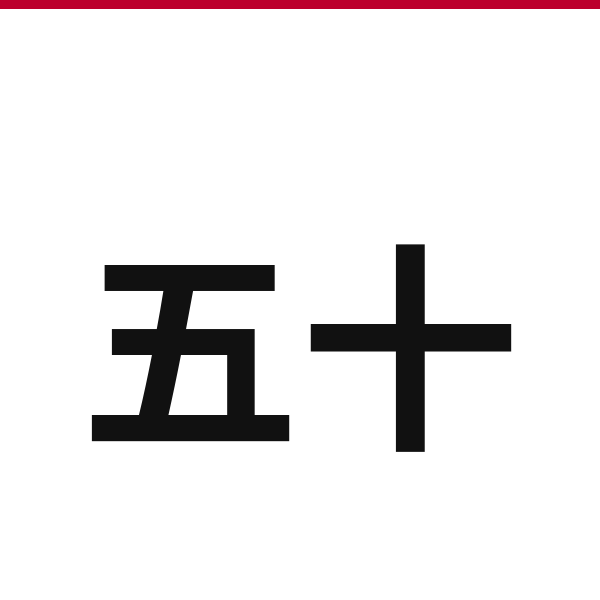
How to use "50" in a sentence
Here are practical examples in polite everyday Japanese:
Other ways of saying "50" in Japanese
Japanese has multiple counting systems, so "50" changes depending on what you are counting:
- gojuu (五十) — Standard number 50.
- gojuu-mai (五十枚) — Counter for flat objects — 50 sheets, tickets, or shirts.
- gojuu-hon (五十本) — Counter for long objects — 50 bottles, pencils, or umbrellas.
- gojuu-dai (五十台) — Counter for machines and vehicles — 50 cars, computers, or televisions.
- gojuu-sai (五十歳) — Age — 50 years old.
- gojuu-nin (五十人) — Counter for people — 50 people.
Fifty is the halfway mark to one hundred, building directly on 40 in Japanese with the same tens logic. From gojuu, jumping to 600 in Japanese shows how the hundred-counter transforms into a more complex reading. If you are interested in how 50 relates to language structure, 18 in Japanese demonstrates the teen patterns that eventually lead to these larger round numbers.
Fun fact about "50" in Japanese culture
Every Japanese child masters the gojuuon (五十音), the 50-sound chart that forms the absolute foundation of Japanese literacy. This grid organizes hiragana and katakana by vowel and consonant, creating a systematic approach to the language that has remained unchanged for over a thousand years. Children chant the gojuuon in order during elementary school, and foreign learners quickly realize they must memorize it to use dictionaries or read alphabetical indexes. The chart's logic differs fundamentally from Western alphabets because it groups sounds by phonetic family rather than arbitrary sequence, reflecting the Japanese preference for categorization over linear progression.
The fifty-yen coin is one of only two Japanese coins to feature a hole in its center, making it instantly recognizable in a handful of change. The design showcases chrysanthemums on the obverse and the denomination on the reverse, a layout that has remained consistent since 1959. Vending machines and ticket machines use special sensors to detect the hole's presence, and the coin's copper-nickel composition gives it a distinctive silver sheen. Because it is worth exactly half of 100 yen, the 50-yen coin serves as a psychological midpoint in everyday transactions, frequently appearing in train fares and snack prices.
2014 marked the 50th anniversary of the Tokaido Shinkansen, Japan's bullet train that revolutionized global rail travel when it opened in 1964. To celebrate this half-century milestone, JR Central operated special '50th anniversary' trains featuring retro liveries from the original 0 Series and onboard exhibitions documenting the evolution of high-speed rail. This 50-year legacy demonstrated Japan's commitment to rail technology that directly influenced France's TGV, Germany's ICE, and China's CRH systems. For Japanese people, the number 50 represents the durability of an engineering vision that transformed a nation into a connected archipelago.
In Japanese martial arts, the godan (五段) or fifth-degree black belt represents a master who has transcended technical skill and entered the realm of teaching. The five ranks of proficiency appear in judo, karate, kendo, and aikido, with the fifth rank marking the transition from student to sensei. This organizational principle extends to flower arrangement (ikebana), where the fifth stem often completes the structural balance of a display. The number 50 therefore represents accumulated mastery across decades of practice.
Japanese New Year celebrations traditionally feature the first 50 syllables of the gojuuon written on decorative cards called karuta, which families play as a competitive memory game. This tradition dates back to the Edo period and remains popular at temple festivals and school events. The 50-syllable system is so culturally embedded that Japanese keyboard layouts and smartphone input methods are organized around it. For foreigners, mastering these 50 sounds is the first real milestone in learning Japanese, making the number 50 synonymous with linguistic initiation.
The fifty-yen coin's hole has inspired countless Japanese design innovations beyond currency. Architects have incorporated circular cutouts into building facades as earthquake-resistant features, and product designers use the hole as a metaphor for functional simplicity. The coin itself is often threaded on strings and hung at shrine entrances as protective amulets. Children collect fifty-yen coins in special piggy banks shaped like Shinto torii gates, and some families gift strings of fifty coins at weddings to symbolize continuous good fortune. The number 50 has transcended mathematics to become a design philosophy in Japanese material culture.