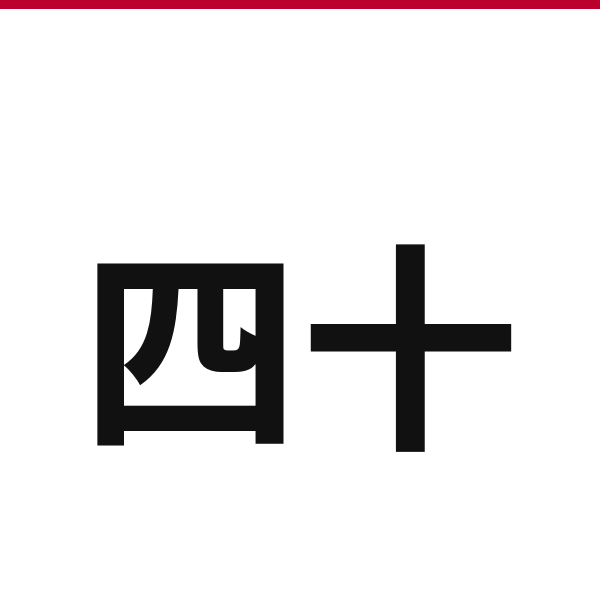
How to use "40" in a sentence
Here are 5 practical examples in polite everyday Japanese:
Other ways of saying "40" in Japanese
Japanese has multiple counting systems, so "40" changes depending on what you're counting:
- yonjuu (四十) — Standard number 40.
- yonjuu-mai (四十枚) — Counter for flat objects — 40 sheets/tickets.
- yonjuu-hon (四十本) — Counter for long objects — 40 bottles/pencils.
- yonjuu-dai (四十台) — Counter for machines/vehicles — 40 cars/computers.
- yonjuu-sai (四十歳) — Age — 40 years old.
Forty follows the same multiplication pattern as 30 in Japanese, making it an easy number to master once you understand the tens. From here, 50 in Japanese completes the first half of the hundred. If you want to see how 40 appears in traditional age terminology, 17 in Japanese sits at the opposite end of the age spectrum where youth culture dominates.
Fun fact about "40" in Japanese culture
Traditionally, 40 marked the beginning of shoro (初老), or "first old age," in Japanese culture. While modern definitions pushed this category to 60, many Japanese still view 40 as the moment when youth definitively ends and middle age begins in earnest. Companies host shoro no iwai parties for employees hitting this milestone, and families gather for elaborate dinners where the birthday person receives gifts symbolizing longevity and wisdom. The concept appears in classical literature where samurai and poets reflected on their achievements and regrets at forty, treating it as a spiritual checkpoint rather than just a birthday.
In Japanese Buddhism, the fortieth day after death (shijunichi) is one of the most important memorial services in the mourning cycle. The soul is believed to complete its judgment during this period, and families hold elaborate ceremonies at temples to guide the deceased toward favorable rebirth. This tradition stems from the belief that the dead need 49 days total to reach the afterlife, with the 40th day marking the final stages of transition when the soul is most vulnerable and most in need of family prayers. The number 40 thus carries profound spiritual weight in funeral customs.
Japanese summers regularly hit yonjuu-do (40 degrees Celsius) in inland cities like Kumagaya and Tajimi, triggering national heatstroke alerts. When temperatures reach this threshold, the Japan Meteorological Agency issues special "danger" warnings that appear on every smartphone in the affected region. Companies distribute salt tablets and electrolyte drinks, cities open public cooling centers, and outdoor events are cancelled. The number 40 is etched into Japanese consciousness as the survival limit — a boundary between uncomfortable heat and genuine medical emergency that defines the country's approach to summer safety.
Japanese universities traditionally require forty credits per academic year for graduation, making the number a structural backbone of higher education. A standard bachelor's degree demands 124 credits over four years, with forty credits representing the annual workload that separates full-time students from part-time attendees. This system influences everything from tuition calculations to scholarship eligibility, and students often refer to their progress as 'yonjuu kamo shirenai' (I might get forty credits) as a measure of academic survival. The number 40 is therefore embedded in the anxiety and ambition of Japanese student life.