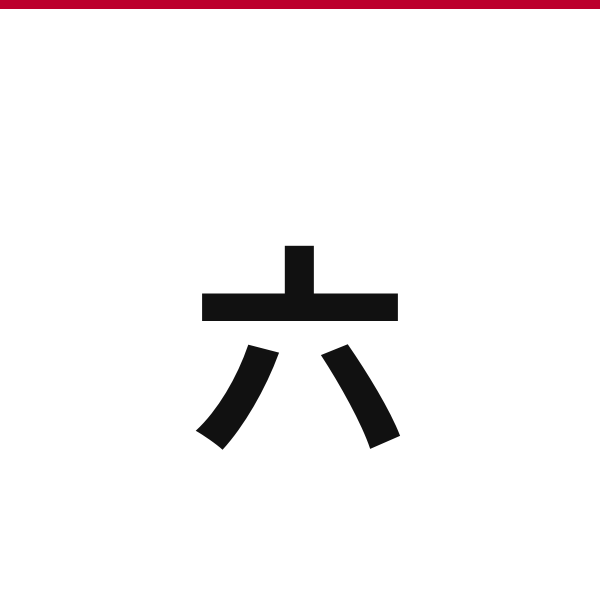
How to use "6" in a sentence
Here are practical examples in polite everyday Japanese:
Other ways of saying "6" in Japanese
Japanese has multiple counting systems, so "6" changes depending on what you are counting:
- roku (六) — Standard number 6.
- roku-mai (六枚) — Counter for flat objects — 6 sheets, tickets, or shirts.
- roku-hon (六本) — Counter for long objects — 6 bottles, pencils, or umbrellas. Note the sound change to 'roppon' after 6, 8, and 10.
- roku-dai (六台) — Counter for machines and vehicles — 6 cars, computers, or televisions.
- roku-sai (六歳) — Age — 6 years old.
- roku-nin (六人) — Counter for people — 6 people.
After mastering 5 in Japanese, 6 is where you officially need both hands to count in the Japanese style. Moving into the twenties, 24 in Japanese shows how the decade pattern works with compound numbers. If you want to see how 6 scales up dramatically, 14 in Japanese combines the 4 pattern with the 10 base.
Fun fact about "6" in Japanese culture
Japanese Buddhism teaches the concept of Rokudo (六道), the Six Realms of existence through which all beings cycle endlessly according to their karma. These realms — heaven, demigods, humans, animals, hungry ghosts, and hell — form the backbone of Japanese moral imagination and appear constantly in manga, anime, and video games. The concept influences daily behavior: good deeds elevate your future rebirth while bad karma drags you downward. Kyoto's Rokudo Chinnoji temple holds an annual ceremony where worshippers visit six sacred locations in a single day to cleanse accumulated negative karma, a tradition that has drawn pilgrims for over 1,200 years.
The Six Ancient Kilns (Nihon Rokkoyo) represent Japan's oldest continuous pottery traditions: Shigaraki, Tanba, Bizen, Tokoname, Echizen, and Seto. These kilns have fired ceramics for over 800 years, producing everything from delicate tea ceremony bowls to massive storage jars that stand taller than a person. Bizen ware is particularly prized because its natural ash glazes create unpredictable patterns that no human hand can replicate. The Rokkoyo embody Japan's dedication to craft traditions that refuse to die even as mass production dominates global manufacturing.
Early June marks the arrival of tsuyu, the seasonal rain front that drenches Japan for four to six weeks. Meteorologists announce 'tsuyu ir' (rainy season entry) with the same gravity as typhoon warnings, and the 6th month is when Japanese people officially switch wardrobes from spring to summer. Despite the gloom, tsuyu brings ajisai hydrangea blooms that carpet temple gardens in blue, purple, and pink clouds. The number 6 is thus tied to transformation in the Japanese calendar — the sixth month is when nature shifts gears and the country prepares for the intense heat of July and August.
In traditional Japanese theater, the rokudan (六段) or sixth-degree master represents the highest level of artistic achievement before entering the hereditary teaching lineage. This ranking system appears in noh, kyogen, and traditional music schools, where the sixth stage signifies complete technical mastery combined with decades of performance experience. The number 6 therefore marks the boundary between practitioner and living legend in Japanese performing arts.
Japanese convenience stores famously sell onigiri in six standard fillings: salmon, tuna mayonnaise, pickled plum (ume), kelp (konbu), cod roe (tarako), and seasoned bonito (okaka). This 'rokushu' (six kinds) system appears in bento boxes, tempura sets, and sushi platters across the country. The number 6 has become shorthand for variety with completeness — enough options to satisfy anyone without overwhelming the decision-making process.