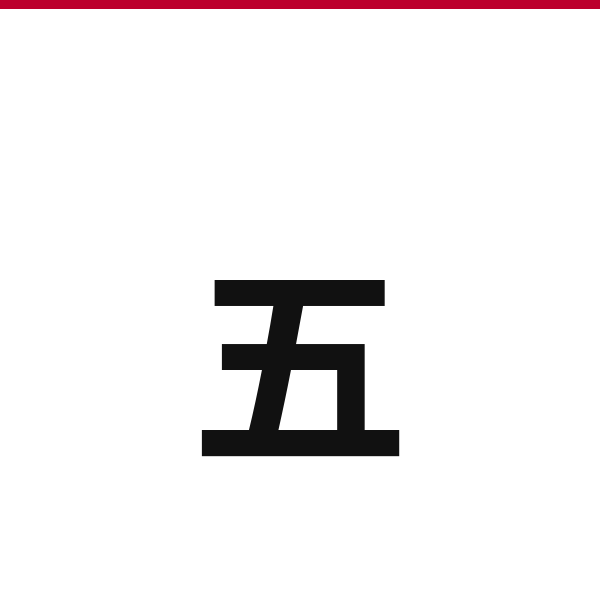
How to use "5" in a sentence
Here are practical examples in polite everyday Japanese:
Other ways of saying "5" in Japanese
Japanese has multiple counting systems, so "5" changes depending on what you are counting:
- go (五) — Standard number 5.
- go-mai (五枚) — Counter for flat objects — 5 sheets, tickets, or shirts.
- go-hon (五本) — Counter for long objects — 5 bottles, pencils, or umbrellas.
- go-dai (五台) — Counter for machines and vehicles — 5 cars, computers, or televisions.
- go-nin (五人) — Counter for people — 5 people.
- go-soku (五足) — Counter for pairs — 5 pairs of shoes or socks.
Building from 4 in Japanese, the number 5 completes your ability to count on one hand, which is exactly how Japanese people gesture numbers in shops and restaurants. Next up is 6 in Japanese, where you will need your second hand. If you are curious about larger groupings, 13 in Japanese shows how the teen pattern stabilizes.
Fun fact about "5" in Japanese culture
May 5th is Kodomo no Hi (Children's Day), one of Japan's most visually spectacular national holidays. Families with sons raise koinobori carp streamers on tall poles outside their homes — a black carp for the father, a red carp for the mother, and blue or green carps for each child. Inside, families display kabuto samurai helmets and iris flowers to symbolize strength and health. The holiday originated from the Chinese Dragon Boat Festival but evolved into a uniquely Japanese celebration that now honors all children regardless of gender. City halls and shopping districts compete to display the largest koinobori arrays, sometimes numbering in the thousands.
The five-yen coin is instantly recognizable as the only Japanese coin besides the 50-yen piece to feature a hole in its center. At Shinto shrines, throwing a 5-yen coin into the offering box is considered the luckiest possible donation because 'go-en' sounds identical to 'goen,' the word for good fortune and meaningful connection. Visitors specifically save 5-yen coins for shrine visits, and some people keep them in wallets as permanent good luck charms. The coin's brass composition and unique design have remained unchanged since 1959, making it one of Japan's most stable cultural objects.
The five-story pagoda (gojunoto) represents the pinnacle of traditional Japanese Buddhist architecture. Each level symbolizes one of the five elements — earth, water, fire, wind, and void — that make up the material world according to Buddhist cosmology. Horyuji Temple in Nara houses the oldest surviving five-story pagoda in Japan, constructed in 607 AD and still standing after centuries of earthquakes. These pagodas are engineering marvels: they sway during seismic activity rather than breaking, a technique that directly inspired modern earthquake-resistant building designs used in Tokyo's skyscrapers today.
Japanese cuisine organizes flavor profiles around what chefs call gomi (五味), the five basic tastes: sweet, salty, sour, bitter, and umami. This fifth taste, umami, was formally identified by Japanese chemist Kikunae Ikeda in 1908 and has since revolutionized global gastronomy. Traditional kaiseki meals are structured around five colors, five cooking methods, and five flavors, creating a dining experience that engages all senses. The number 5 is therefore not just a mathematical concept in Japan; it is a framework for aesthetic perfection.
In Japanese martial arts, the godan (五段) or fifth-degree black belt represents a master who has transcended technical skill and entered the realm of teaching. The five ranks of proficiency appear in judo, karate, kendo, and aikido, with the fifth rank marking the transition from student to sensei. This organizational principle extends to flower arrangement (ikebana), where the fifth stem often completes the structural balance of a display. The number 5 signals completion and mastery across Japanese disciplines.