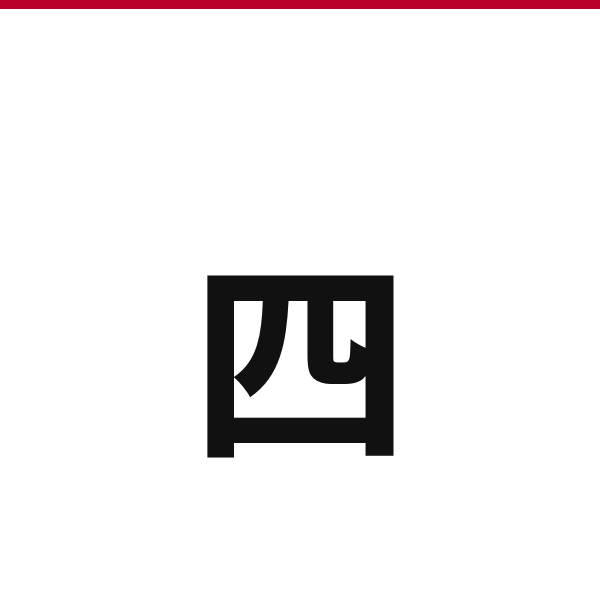
How to use "4" in a sentence
Here are practical examples in polite everyday Japanese:
Other ways of saying "4" in Japanese
Japanese has multiple counting systems, so "4" changes depending on what you are counting:
- yon / shi (四) — Standard number 4. 'Yon' is preferred for counting; 'shi' is used in specific compounds like April (shigatsu).
- yon-mai (四枚) — Counter for flat objects — 4 sheets, tickets, or shirts.
- yon-hon (四本) — Counter for long objects — 4 bottles, pencils, or umbrellas.
- yon-dai (四台) — Counter for machines and vehicles — 4 cars, computers, or televisions.
- yon-sai (四歳) — Age — 4 years old.
- yo-nin (四人) — Counter for people — 4 people. Uses the irregular 'nin' counter.
If you are still getting comfortable with smaller digits, review 3 in Japanese to lock in the basics. Moving forward, 5 in Japanese opens the door to counting on one hand, which is how Japanese people gesture numbers in daily conversation. For a look at how teens work, 12 in Japanese shows the pattern that repeats through the forties.
Fun fact about "4" in Japanese culture
Tetraphobia runs deep in Japan because the word for 4, 'shi,' is pronounced exactly like the word for death. This linguistic coincidence shapes daily life in ways that surprise foreigners. Hospitals routinely skip room numbers containing 4, elevator panels in older buildings jump from floor 3 to floor 5, and giving gifts in sets of four is considered a veiled curse. Some parking lots even omit space 4, and athletes frequently avoid jersey numbers with 4 unless they want to project a rebellious image. However, the alternative reading 'yon' carries no negative baggage, which is why Japanese speakers instinctively switch to 'yon' when counting objects or people.
Despite the superstition, the concept of Four Seasons (shiki) is celebrated with unmatched enthusiasm in Japan. Unlike Western cultures that sometimes reduce the year to summer and winter, Japanese tradition honors all four with distinct culinary practices, seasonal vocabulary, and aesthetic rituals. Spring brings hanami cherry blossom viewing parties where families picnic under pink canopies, summer explodes with fireworks festivals and yukata-clad crowds, autumn triggers momiji maple leaf hunting in mountain temples, and winter centers on kotatsu warmth and nabe hot pot gatherings. The word 'shiki' appears in restaurant names, poetry, and fashion lines because the four-season cycle defines the Japanese sense of time.
Japan's identity is also built on the Four Great Islands — Honshu, Hokkaido, Kyushu, and Shikoku — which together comprise 97% of the nation's land area. Each island maintains distinct dialects, regional cuisines, and cultural identities that create a surprisingly diverse country. Hokkaido supplies Japan with dairy products and world-class skiing, Kyushu bubbles with volcanic hot springs and tonkotsu ramen, Shikoku hosts the famous 88-temple Buddhist pilgrimage, and Honshu contains the urban powerhouses of Tokyo, Osaka, and Kyoto. Japanese children learn this four-island geography before they learn multiplication, embedding the number 4 into national consciousness from kindergarten onward.
Japanese architecture traditionally organizes space around the concept of shiho (four directions), with buildings oriented to face south and gardens designed to be viewed from four angles. The tatami mat system, which measures rooms by the number of mats, often uses 4.5-tatami or 6-tatami as standard sizes, but the 4-mat room (yojohan) holds special significance as the traditional size for a tea ceremony space or a monk's quarters. This spatial relationship with the number 4 shows how deeply the digit is woven into the physical environment of Japanese life.
In classical Japanese poetry, the four-line form known as the kanshi (Chinese-style poem) and the four-character idiom (yojijukugo) represent compact expressions of complex philosophy. Japanese students memorize hundreds of yojijukugo throughout their education, using four characters to capture entire concepts like 'isseki nichou' (killing two birds with one stone). The number 4 thus functions as a container for wisdom in Japanese literacy, proving that even a digit associated with death can carry intellectual life.