Why Japanese Textbooks Are a Joke (And What Works)
May 4, 2026
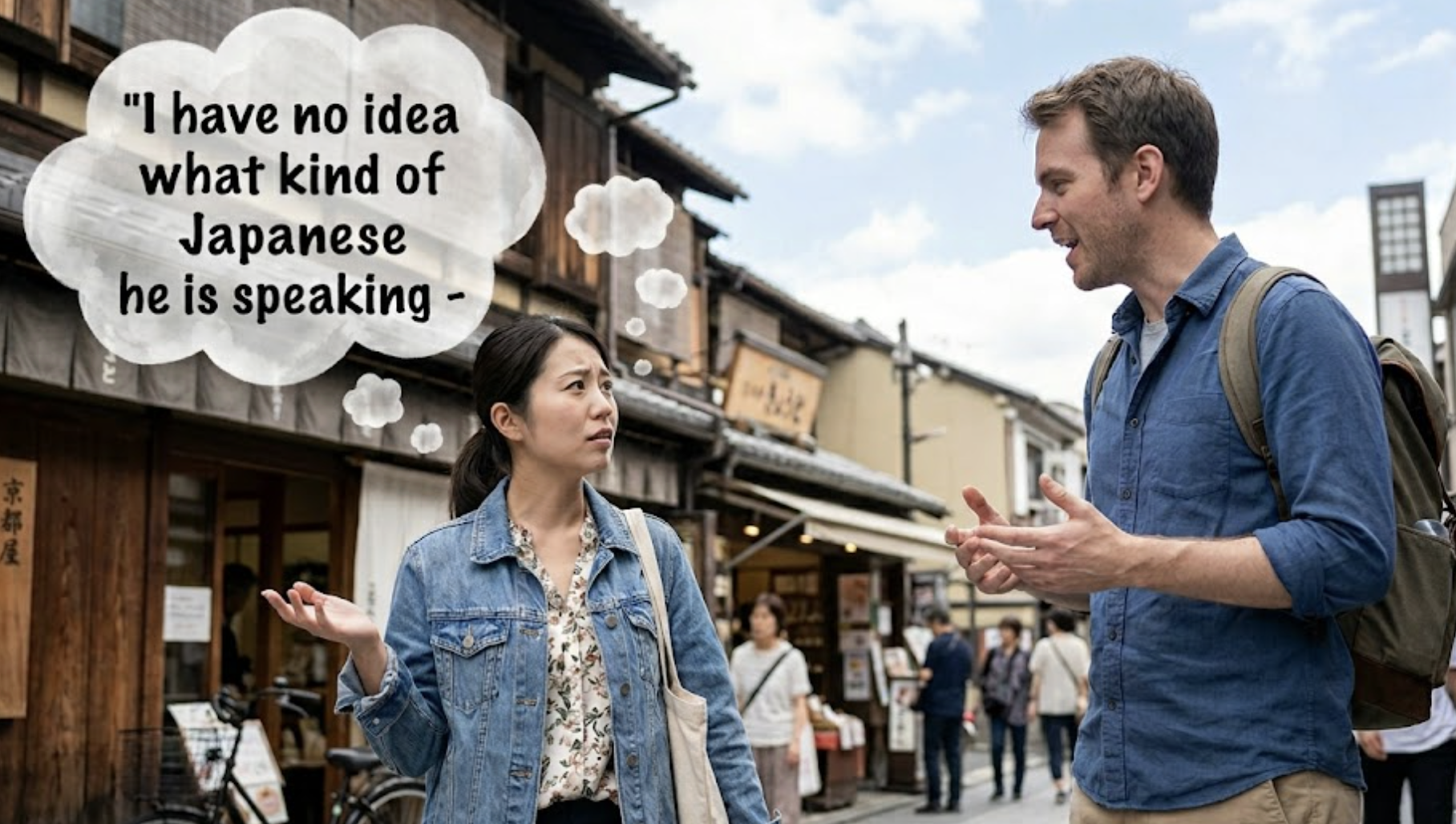
You open Genki. You learn that Tanaka-san is a student. That Yamada-sensei teaches at a university. That someone named Mary is from America, and she is going to the library on Saturday. That's nice, but none of this will help you survive a single conversation with an actual Japanese person. This is the central lie of Japanese language textbooks: they teach you a version of Japanese that nobody speaks, in situations that almost never occur, using patterns that will leave native speakers genuinely puzzled. You spend months mastering polite verb conjugations and emerge completely helpless the moment someone talks back to you like a real human being.
The Politeness Trap
Textbooks are obsessed with teineigo — the formal, polite register. Every sentence ends in -masu or -desu. Every dialogue sounds like a job interview conducted in slow motion. Here's what they don't tell you: outside of work meetings, convenience store transactions, and talking to people significantly older than you, nobody talks like this. Your friends don't. People on the street don't. Anyone under 35, speaking casually, drops the -masu endings entirely. They clip words. They swallow sounds. They use sentence fragments that would make your textbook author reach for a red pen.
You learn tabemasu (I eat). The actual word you'll hear from your friend is taberu, or more likely just taberu yo, or tabeta? (did you eat?), which sounds completely different and lands with entirely different social weight. You weren't taught any of that. You were taught a museum exhibit.
The result is a learner who can pass a written test and cannot order food without freezing up when the waiter responds in actual Japanese.
The Dialogue Problem
Textbook dialogues are written by academics who apparently haven't had a casual conversation since 1987. The exchanges are clean, complete, and utterly fake. Real spoken Japanese is interruptions, filler sounds, half-finished sentences, and meaning carried as much by tone and context as by words.
Nanka sa — (like, you know —) Tte iu ka — (or rather —) Yabai (used to mean roughly everything)
None of this is in Genki.
None of it is in Minna no Nihongo.
It exists in the space between textbook chapters that nobody writes. When Japanese people are surprised, they don't say "Hontou ni?" the way your textbook suggests. They say "Uso!" (literally "lie!" but functionally "no way!"). They say "Majide?" They say "Ehhhhh" with a rising intonation that communicates seventeen things at once. These are the words that make you sound like a person instead of a language-learning software demo.
Grammar as a False God
Textbooks front-load grammar. Learn the structure, they say, and the rest will follow. So you learn te-form. You learn conditional if-clauses. You learn passive causative constructions that you will use approximately never in casual speech.
Meanwhile you still can't say "that's kind of a lot" or "I'm not really feeling it today" in a way that doesn't sound bizarre.
Spoken Japanese is not grammar-first. It's feel-first. Native speakers don't think about te-form when they're talking. They're pattern-matching against thousands of hours of exposure. You can't shortcut that with conjugation tables. You can only get there by hearing and using real language until the patterns sink into something below conscious thought.
Grammar rules are the scaffolding. They're not the building.
What Textbooks Get Right (The Short List)
To be fair: hiragana and katakana instruction is genuinely solid in most textbooks. The writing systems are logical and learnable, and the drills work. Basic sentence structure — subject, object, verb at the end — is also taught correctly, even if the examples are lifeless.
And some grammar foundations are worth having early. Particles like wa, ga, ni, de, wo are genuinely confusing at first and benefit from explicit explanation. That's roughly where the honest praise ends.
What Actually Works
Listening to real speech at volume. Not NHK news. Not formal YouTube lessons. Actual variety shows, comedy, drama. The stuff where people talk over each other and abbreviate everything. You will understand very little for weeks. Then you'll start catching fragments. Then sentences. This is the process and there is no shortcut.
Learning words in context, not in lists. Vocabulary lists are nearly useless. A word you've seen in a real sentence — in a show you watched, a conversation you had — stays in your head. A word from a Quizlet deck usually doesn't. Your brain files words by situation, not by alphabetical order.
Shadowing. Listen to a native speaker, pause, repeat what they said with the same rhythm, same pitch, same speed. Do it until your mouth knows where to go. The sounds of casual Japanese are different enough from textbook Japanese that your mouth literally has to learn new muscle patterns.
Getting corrected by real people. Apps can't do this well. Language exchange partners can. The moment someone native tells you "we don't really say it that way" is worth ten grammar drills. And it's never said unkindly — Japanese people are almost universally warm toward people genuinely trying to learn their language.
Using a tool that reflects real usage. When you encounter a phrase in the wild and want to understand how it actually functions — not just what the dictionary says — being able to look it up and see real translations helps. This is how a lot of people use something like RealNihongo's translator: not to replace study, but to reality-check what they're learning against actual Japanese. There's a gap between textbook Japanese and spoken Japanese, and having something that leans toward the latter matters.
The Real Issue With Textbooks
The deeper problem isn't that textbooks are badly written — some of them are actually carefully constructed. The problem is that they're optimized for teachability, not usability.
A classroom needs structure. A curriculum needs measurable progress. So textbooks give you things that are easy to test: grammar points, vocabulary lists, formal dialogues with clear right and wrong answers. What they can't test — and therefore don't teach — is the messy, living, social reality of how Japanese actually functions between people who like or tolerate each other.
Japanese is also a language where register shifts constantly based on who's in the room. The way you speak to a friend is so different from how you speak to a boss that it's almost a different language. Textbooks pick one register (polite), drill it until you're fluent in something useful in roughly 30% of real situations, and send you out into the world.
The Honest Starting Point
Everyone finds the door differently. Some people need to write things down before anything sticks — tracing characters, building muscle memory, seeing the script take shape on paper. For them that's not busywork, that's how the brain files it away. Others need to speak first, grammar be damned. They mispronounce something, a native speaker corrects them warmly, and something clicks. That moment of actual human reaction — someone responding to you in real Japanese, understanding you, engaging with you — that's the hit. And once you get that hit, the motivation problem more or less solves itself. You go looking for the next one.
Some paths that have worked for people:
Writing the scripts by hand. Hiragana and katakana through repetition, not apps. Slow, tactile, effective for a certain kind of learner.
Diving into listening first. Shows, music, YouTube — exposure before structure. Let the sounds become familiar before worrying about what they mean.
Finding one conversation partner and talking badly. Broken Japanese with a real person beats perfect Japanese with a textbook character every time — for the people this works for.
Using translation as a reality check. Some people start by typing phrases they actually want to say into something like our translator not textbook sentences, but things they'd genuinely say to someone. Seeing how that maps to real spoken Japanese, hearing how a native speaker would actually phrase it, can be that first spark. The moment it stops feeling like study and starts feeling like communication — that's when some people get hooked.
None of these is the way. They're options. The only wrong move is waiting until you feel ready — because that feeling doesn't come before you start. It comes somewhere in the middle, usually right after the first time someone understands you and responds like you're a person, not a language student.
Pick what fits. Start there.
The goal was never to speak like Tanaka-san discussing his commute to the university. The goal is to sit across from someone in an izakaya and hold your end of the conversation — to be understood, to understand back, and to feel something like fluency in a language that rewards everyone who sticks with it.
That doesn't come from a textbook. It comes from showing up, listening hard, and refusing to stay comfortable.