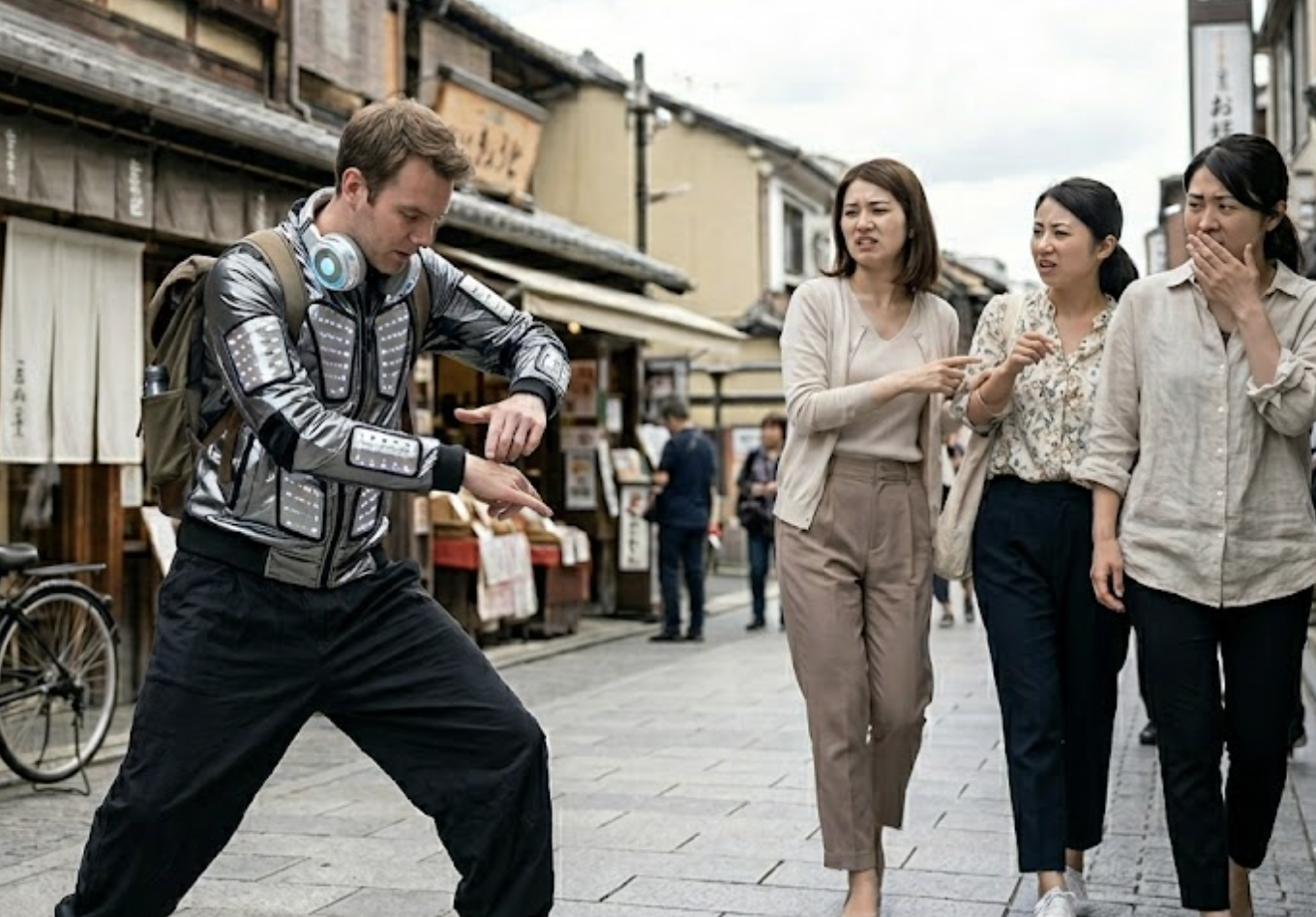
My Japanese Sounds Like A Robot
May 4, 2026
You've been studying for months. You know your verb forms. You can conjugate in your sleep. You sit down across from a Japanese person, open your mouth, and watch their expression shift — not confused exactly, just slightly... off. Like something doesn't quite fit.
You don't sound wrong. You sound like a textbook.
And in real conversation, that's almost the same thing.
The Robot Tell
There's a specific quality to textbook Japanese that native speakers clock immediately. It's not your accent. It's not your grammar. It's the smoothness. Every sentence complete. Every thought fully formed. No hesitation, no filler, no trailing off. Just clean, correct, robotic output.
Real human speech doesn't work like that. In any language, people think out loud. They backtrack. They soften things. They leave sentences unfinished because context fills the rest. Japanese, more than most languages, has an entire system built around this — sounds, endings, and particles that do nothing but make speech feel human.
Textbooks teach almost none of it.
Filler Sounds Are Not Wasted Words
In English you say "um," "like," "you know," "I mean." These aren't mistakes — they're social signals. They tell the listener you're still thinking, that you're being genuine, that you're not reading from a script.
Japanese has its own set:
Eto — the classic thinking pause, like "umm" Ano — softer, slightly more hesitant, like "uh" Nanka — "like" or "kind of," used constantly by younger speakers Ma — a resigned, accepting filler, roughly "well" or "I mean" Sou desu ne — "that's right, isn't it" — used to show you're listening, not just waiting to talk
If you never use these, you sound like you're reciting. Worse, you can sound cold — like you're not really present in the conversation. Japanese communication relies heavily on back-and-forth acknowledgment. The listener is expected to respond, react, signal they're following along. Silence where a nanka or sou ne should be creates a strange gap that people feel even if they can't name it.
Sentence Endings Are Doing More Than You Think
Textbooks teach you that sentences end in -masu or -desu or plain form. What they don't teach is the layer of nuance sitting right at the end of almost every casual sentence.
Ne — seeks agreement, softens, invites connection. "It's hot today, ne." Yo — asserts, emphasizes, adds confidence. "That place is good, yo." Kedo — "but" or "though," used to soften or trail off. "I kind of want to go, kedo —" Na — self-directed, reflective, almost like thinking out loud. "That was good, na." Mon / Mono — explains or justifies with a slightly soft or childlike tone. "Because I was tired, mon."
These tiny endings carry enormous social weight. Drop ne into the right place and you've invited someone into your thought. Use yo too much and you come across as aggressive. Use neither and your sentences land flat, statements dropped into the air with nothing to catch them.
Textbooks mention ne and yo briefly. They don't tell you that fluent use of sentence-final particles is basically what separates someone who speaks Japanese from someone who sounds like they're translating in their head in real time.
Formality Is a Dial, Not a Switch
Here's something no beginner course explains clearly: formality in Japanese isn't a choice you make once. It's a dial you're adjusting constantly, sometimes mid-sentence, based on who you're talking to, what you're talking about, the setting you're in, and the relationship you want to signal.
Friends slip between casual and semi-formal depending on whether they're joking or being serious. Colleagues talk one way in meetings and another way at dinner afterward. Even within a single conversation the register shifts. You're not supposed to pick polite Japanese and stay there — that's not a social register, it's a holding pattern.
Learners who only know formal Japanese aren't just limited — they're inadvertently signaling distance. Stiff, complete, fully conjugated sentences between people who should be comfortable with each other create an awkwardness that's hard to explain but easy to feel. It's the linguistic equivalent of shaking hands with a close friend.
The Fix Is Simpler Than You Think
You don't need to overhaul your study plan. You need to start paying attention to the right things.
Watch shows where people actually talk to each other — not news, not educational content, not anything written for learners. Listen for the fillers, the trailing endings, the half-sentences. Notice how people respond before the other person finishes. Notice what ne sounds like when it's warm versus when it's checking.
Then start using one new thing at a time. Just nanka for a week. Get comfortable with it. Then add kedo as a way to soften. Then start noticing your sentence endings and whether they're landing or just stopping.
When you're building phrases or checking how something would actually be said — not how a dictionary would say it, but how a person would — a tool like RealNihongo can help you hear the difference between the formal version and the version someone would actually use on a Tuesday afternoon. As you can see the break down in words.
The goal isn't to sound casual. The goal is to sound present. Like someone who's actually there in the conversation, thinking in real time, responding to a real person.
That's what the fillers do. That's what the sentence endings do. They're not decoration. They're the proof of life in your Japanese.